
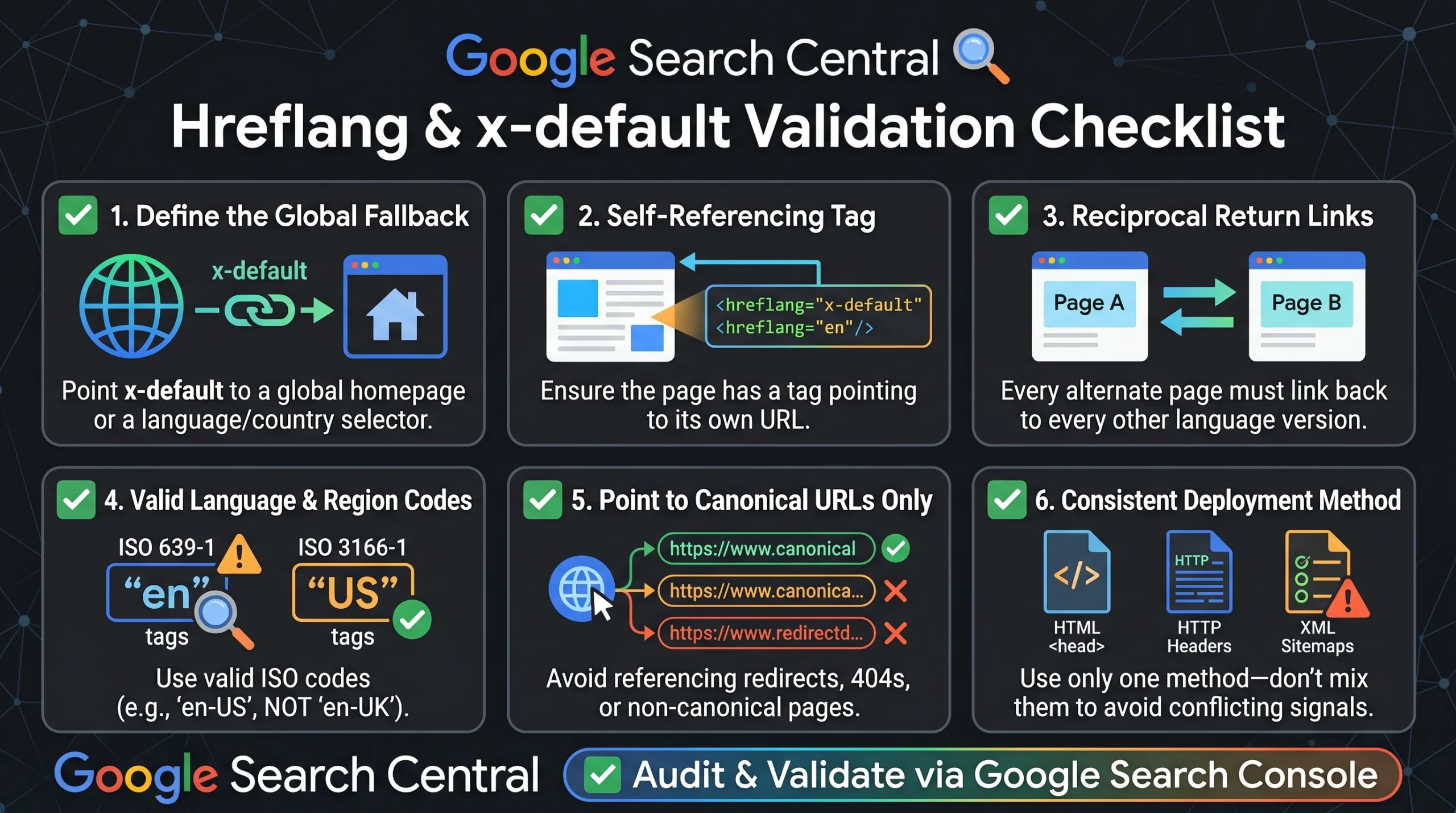
Google Search Central hreflang guidelines for x-default are most useful when you turn them into a repeatable quality check. A site can have technically valid HTML and still send users to the wrong page. The goal is to confirm both the annotation and the experience behind it.
This guide is a validation checklist for editors, developers, and SEO teams. It does not repeat a basic setup tutorial. Instead, it explains what to inspect before publishing, after a redesign, and whenever a new language is added. Google’s official localized versions guide provides the underlying rules.
Check 1: Are these really equivalent pages?
Start with the content. A French product page and its English translation can belong to one hreflang group. A French homepage and an English product page usually should not. Matching URLs by folder name alone is not enough; the page purpose and main content should align.
Open each version and compare its headline, offer, main product, and key information. Regional prices and shipping details may differ while the overall page purpose stays the same. Record exceptions rather than linking unrelated pages just to fill a missing language.
Check 2: Does every version list itself?
Every language version should include a self-referencing hreflang entry. This is easy to miss when code is copied from a different language template. An English page must include the English URL, not only the Spanish and German URLs.
Check 3: Do return links work?
A return link is the annotation on the alternate page that points back to the original page. Google expects reciprocal relationships. If the English page references German, the German page should reference English. Broken reciprocity can cause affected tags to be ignored.
Test this after a new language launch. Teams often update the original language page but forget to regenerate the tags on older translated pages. The Degates hreflang tag generator can help assemble a consistent set from a checked URL list.
Check 4: Are the codes supported?
Use supported language codes and optional supported region codes. Examples include en, es, en-US, and en-GB. A region alone is not valid. The string x-default is a special fallback value, not a language abbreviation.
Avoid guessing region codes from common names. The United Kingdom uses GB in the relevant region standard, so en-GB is appropriate. If a page targets English speakers everywhere, the simple en value may be better than an arbitrary country code.
Check 5: Is every URL absolute and reachable?
Inspect each href value. It should contain the full protocol, hostname, and path. Then load the destination directly. Check for 404 errors, unexpected redirects, or pages that require a login. A beautiful annotation cannot fix a destination that users cannot open.
Check 6: Is the x-default destination helpful?
A fallback page should make sense for unmatched visitors. If your site serves four languages, a selector can let visitors choose. If you serve one primary international version, that page may be an acceptable default. Do not point x-default to a sales campaign simply because it has the highest conversion rate.
Test the fallback without assuming the visitor speaks English. Are the language choices visible? Can someone switch regions without being trapped in an automatic redirect? Is the page usable on mobile? These are editorial and usability checks, not just SEO checks.
Check 7: Are canonical tags consistent?
Inspect the canonical declaration on each localized URL. A translated page intended for indexing will generally use its own canonical. If it points to an unrelated language version, the canonical and hreflang signals may conflict. Use the canonical tag generator to review syntax, then confirm the intended URL.
Check 8: Is the annotation in the correct location?
For HTML implementations, alternate links belong inside a valid head section. For sitemap implementations, use the required xhtml namespace and entries for every alternate. For PDF files, HTTP headers may be easier. Choose one method and validate its actual output rather than relying on plugin settings alone.
<link rel="alternate" hreflang="en-US" href="https://example.com/us/help/" />
<link rel="alternate" hreflang="fr-FR" href="https://example.com/fr/aide/" />
<link rel="alternate" hreflang="x-default" href="https://example.com/help/" />
Check 9: Did the launch break internal navigation?
Hreflang and visible language links serve different purposes. Visitors still need an obvious way to change language. Check the header menu, footer, language selector, and links within important account or checkout flows. A language version that is difficult to navigate can lose users even with perfect annotations.
Check 10: Is there a maintenance owner?
Assign responsibility for reviewing hreflang whenever a page is deleted, renamed, translated, or redirected. A simple monthly audit can catch stale URLs. Include hreflang in your broader website SEO audit process rather than treating it as a one-time task.
A simple pass-or-fail workflow
Create one row for each alternate group and record: equivalent content, self-reference, reciprocal links, valid codes, absolute URLs, successful responses, useful x-default page, and consistent canonicals. Mark a group as ready only when all critical checks pass. Recheck after deployment because production templates may differ from staging.
Frequently Asked Questions
Does a valid x-default tag guarantee better rankings?
No. It helps Google understand the fallback relationship; ranking depends on many other factors.
Should every translated page repeat the same alternate set?
For a given group of localized pages, the corresponding alternate set should be consistent across versions.
Can the x-default page be a language selector?
Yes. That is one of the clearest uses described in Google’s guidance.
What should I test after a migration?
Check destination URLs, redirects, canonical tags, reciprocal hreflang entries, and visible language navigation.
Final takeaway
A good x-default checklist checks meaning as well as markup. Equivalent pages, reciprocal relationships, accessible URLs, and a useful fallback are the foundations. Use the checklist every time your multilingual site changes.
Leave a Reply