On Page Seo Audit works best when the advice begins with a real problem. Inspect the elements a search engine and a visitor encounter on an individual page. This guide explains the decisions behind the process, shows how to test them, and separates useful practices from common assumptions. It is written for readers who want a repeatable method rather than a promise of instant rankings.
The challenge with on page SEO audit is not simply finding a phrase to repeat. People arrive with different expectations, levels of knowledge, and next steps. A helpful article makes those differences clear. We will use practical examples, define what success might look like, and show which signals should be treated cautiously.
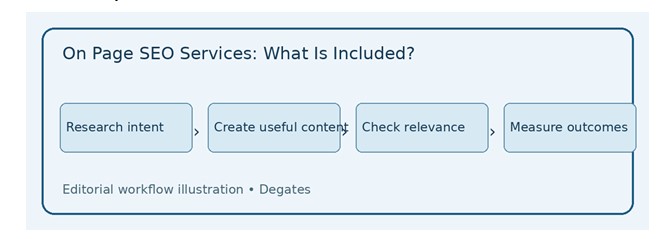
Figure: A simple on page SEO audit planning and review workflow.
Define the page and business objective
A service page may need inquiries, while a tutorial may need readers to complete a task. Before editing metadata, choose the page’s primary audience and next action. The same checklist cannot be applied blindly to a pricing page and a troubleshooting guide. Align the keyword with the actual offer and the questions a visitor needs answered.
For on page seo audit: a step-by-step process, begin with a real scenario instead of a list of abstract recommendations. Start with a page that receives impressions but few relevant clicks. Compare its title and introduction with the query. Then check its canonical, headings, internal links, and mobile presentation. The practical question is whether the page or post gives a person enough information to decide what to do next. If the answer is unclear, adding the phrase ‘on page SEO audit’ several more times will not solve the problem. Rewrite the explanation until the benefit and limitation are both obvious.
Review intent and the search results
Look at the kinds of pages that appear for the query: guides, service providers, tools, or local results. A company offering optimization services should not promise that a short definition page will compete with detailed service comparisons. Use search results as evidence of likely intent, while remembering that they change by location and time.
A second way to test the recommendation is to compare two reasonable choices. A page can have a green plugin score while still failing to answer the user’s question. Document both machine-detectable problems and editorial judgment. Note what changes between them: the audience, the task, the format, or the evidence. This comparison gives the reader a decision rule they can reuse, which is more valuable than a checklist that treats every situation as identical.
Inspect the title, description, and headings
A useful title describes the page without exaggeration. The meta description can summarize the value, although Google may generate another snippet. Use one clear main heading and descriptive sections that make scanning easy. Avoid duplicating the same title across dozens of pages or treating a plugin’s color indicator as the objective.
Work through the change in a small test before applying it everywhere. Record the original wording, what you adjusted, and the reason. Ask whether someone unfamiliar with the project would understand the example without a sales pitch. If not, add the missing context. The purpose of on page SEO audit is to make useful information easier to find and understand, not to disguise thin content with terminology.
Check copy, links, and media
Answer the main question early, add examples, and remove claims that cannot be supported. Link to relevant pages using descriptive anchor text, not repeated exact-match phrases. Check that images load, support the content, and have appropriate alternative text. Include citations where readers need to verify standards or factual claims.
Finally, consider what could go wrong. A broad phrase may attract the wrong audience; an attractive headline may promise more than the content delivers; and a metric may improve without creating business value. Explain these trade-offs to readers. A clear limitation is a sign of careful advice, not a weakness. It also makes future revisions easier because the original assumptions are visible.
Review technical signals in context
Inspect indexability, canonical references, mobile layout, redirects, and structured data where relevant. These are not interchangeable fixes: a canonical tag does not guarantee indexing, and a redirect should not be added merely to make an audit score look better. Test the page after changes and keep a record of what was modified.
For on page seo audit: a step-by-step process, begin with a real scenario instead of a list of abstract recommendations. Start with a page that receives impressions but few relevant clicks. Compare its title and introduction with the query. Then check its canonical, headings, internal links, and mobile presentation. The practical question is whether the page or post gives a person enough information to decide what to do next. If the answer is unclear, adding the phrase ‘on page SEO audit’ several more times will not solve the problem. Rewrite the explanation until the benefit and limitation are both obvious.
Prioritize by impact and effort
Start with broken pages, missing or misleading titles, severe mobile usability issues, and content that does not answer its query. Cosmetic changes can wait. For a ten-page business site, a targeted review may be enough; a large catalog often needs templates, sampling, and careful deployment controls.
A second way to test the recommendation is to compare two reasonable choices. A page can have a green plugin score while still failing to answer the user’s question. Document both machine-detectable problems and editorial judgment. Note what changes between them: the audience, the task, the format, or the evidence. This comparison gives the reader a decision rule they can reuse, which is more valuable than a checklist that treats every situation as identical.
Ask for evidence, not guaranteed rankings
A useful deliverable identifies the URL, issue, recommendation, owner, and verification method. Rankings and traffic are influenced by competition and factors outside on-page work. Ask a provider to explain what they changed and why, not to promise first position by a specific date.
Work through the change in a small test before applying it everywhere. Record the original wording, what you adjusted, and the reason. Ask whether someone unfamiliar with the project would understand the example without a sales pitch. If not, add the missing context. The purpose of on page SEO audit is to make useful information easier to find and understand, not to disguise thin content with terminology.
Maintain and measure improvements
Record a baseline in Search Console and analytics before changes. Watch relevant impressions, clicks, engagement, conversions, and technical issues over a reasonable period. Annotate major site changes so later movement is easier to interpret. Revisit pages when offers, facts, or user questions change.
Finally, consider what could go wrong. A broad phrase may attract the wrong audience; an attractive headline may promise more than the content delivers; and a metric may improve without creating business value. Explain these trade-offs to readers. A clear limitation is a sign of careful advice, not a weakness. It also makes future revisions easier because the original assumptions are visible.
A practical implementation example
Start with a page that receives impressions but few relevant clicks. Compare its title and introduction with the query. Then check its canonical, headings, internal links, and mobile presentation.
Imagine a small team reviewing on page SEO audit on Monday. One person gathers examples, another checks whether the content answers the audience’s question, and a third verifies the live result. The team records one main decision for each page or post. This makes responsibility visible and prevents an audit from turning into a collection of suggestions nobody implements.
A page can have a green plugin score while still failing to answer the user’s question. Document both machine-detectable problems and editorial judgment.
On Friday, the team reviews what actually changed. It does not infer causation from one chart or assume every increase came from its latest edit. Instead, it compares the original goal with the observable result, documents uncertainties, and decides whether to keep, revise, or stop the approach. That habit makes future work more reliable.
Common questions
How quickly does on page SEO audit produce results?
There is no universal timeline. Results depend on competition, existing visibility, the quality of the work, audience behavior, and how often platforms process changes. Use a baseline and review trends rather than a guaranteed date.
Should I repeat ‘on page SEO audit’ in every heading?
No. Use the focus phrase naturally where it helps the reader, including an early introduction and a relevant heading. Related wording and clear explanations matter more than mechanical repetition.
Can a checklist replace expert review?
A checklist catches omissions, but it cannot fully judge whether the content meets a person’s need. Combine basic technical checks with editorial judgment and evidence from actual users.
Related Degates resources
Degates SEO tools and page analyzer — review page-level titles, descriptions, headings, and related signals.
Degates Meta Tag Generator — create draft title and social metadata for a web page.
Degates SEO insights — explore additional SEO guides and practical explanations.
External sources and further reading
Google SEO Starter Guide | Google link best practices
Final takeaway
Treat on page SEO audit as a structured decision process: identify the audience’s real question, provide a useful answer, make it accessible, and review outcomes with appropriate caution. The strongest improvements are understandable to the people using the content. Keep the workflow simple enough to repeat and specific enough to audit.
Leave a Reply