
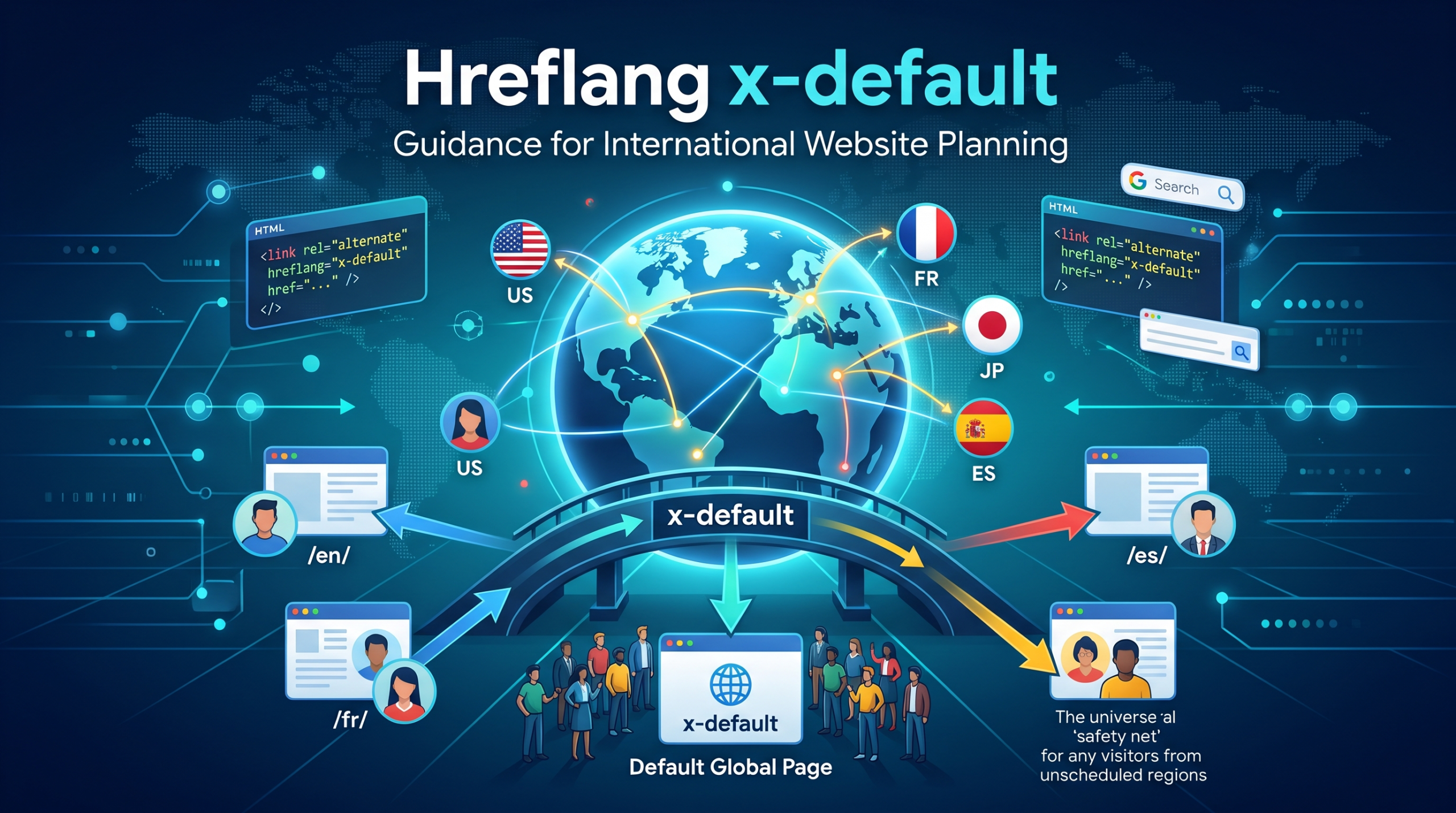
Google hreflang x-default guidance is not only a developer topic. It affects how an international website welcomes visitors, organizes languages, and handles people outside its main markets. Choosing a fallback is a product decision as much as an SEO decision.
This article is for business owners and content teams planning a multilingual site. Instead of repeating implementation steps, it compares fallback strategies and explains how to maintain them as a company grows. The technical foundation is described in Google Search Central’s official guidance.
Decide who your website actually serves
Start by listing the languages and countries for which you have useful content, customer support, pricing, and delivery options. A company may sell in the United States and Germany but receive visitors from dozens of other countries. Those visitors still need a reasonable way to understand what the company offers.
Do not assume that a visitor’s country always reveals their preferred language. A person living in Germany may prefer English. A visitor traveling abroad may want the same site version they use at home. Your fallback should preserve choice rather than locking people into a guessed region.
Option 1: A neutral language selector
A language selector works well when you offer several regional experiences with meaningful differences. The visitor can choose a country or language before browsing. This is especially useful when pricing, shipping, legal terms, or product availability vary widely.
The selector should be easy to use on a phone, explain the available options, and avoid confusing flags as the only language labels. A flag represents a country, not a language. A visible text label such as English (United Kingdom) is clearer.
Option 2: A generic international page
A generic English page can be a reasonable fallback if English is your most useful shared version. It should explain international availability and make it easy to switch languages. It should not pretend that every visitor has the same shipping terms or currency.
This option may be easier for a small company to maintain than a dedicated selector. However, it becomes less helpful if the business expands into markets with different legal or product requirements. Revisit the decision when the website grows.
Option 3: A default regional version
Some businesses have one market that represents their default experience. Google permits x-default to point to a content version that the site treats as default. This can work when the page is genuinely useful to unmatched visitors and offers a clear path to other versions.
The risk is treating a regional page as universal. If a visitor sees prices, tax rules, or shipping promises that do not apply to them, the experience can be misleading. Evaluate the page as a visitor would, not only as a search engine would.
Plan URL architecture before translating pages
Choose a consistent pattern such as /en/, /de/, and /fr/ folders or stable language-specific domains. There is no need to move every language to a separate domain simply to use hreflang. The right choice depends on operations, localization needs, and technical resources.
Each content group should connect equivalent URLs. A German returns-policy page should correspond to the English returns-policy page, not the English homepage. Build an editorial map that identifies which pages have real translations and which languages are not yet supported.
Treat fallback design as part of accessibility
People should be able to change languages after landing on a page. Avoid automatic redirects that make it impossible to choose another locale. Keep language names readable, make controls keyboard accessible, and preserve the visitor’s selection when practical.
A visitor arriving from search may want a specific product, not a generic homepage. Where possible, offer a neutral version of the same product or a selector that preserves context. That reduces unnecessary steps and makes the fallback genuinely useful.
Coordinate editorial and technical teams
The content team decides whether a translated page is ready. Developers ensure its URL works and annotations are correct. SEO reviewers check canonical consistency, indexing, and return links. No single team should silently add x-default across an entire site without confirming the fallback experience.
Create a simple ownership document: the page group, supported languages, default destination, canonical URL, and the person responsible for updates. When a translation is removed or a regional storefront closes, update the mapping at the same time.
A sample launch plan for three markets
Imagine a travel company with English, French, and Japanese versions of its booking information. The team decides that a neutral language chooser is the safest fallback because offers and support differ by region. The content team prepares matching pages, the developer generates alternate links, and QA checks the selector on mobile.
<link rel="alternate" hreflang="en" href="https://example.com/en/trips/" />
<link rel="alternate" hreflang="fr" href="https://example.com/fr/voyages/" />
<link rel="alternate" hreflang="ja" href="https://example.com/ja/trips/" />
<link rel="alternate" hreflang="x-default" href="https://example.com/choose-language/" />
The sample shows the relationship, not a universal URL plan. Every live version should contain its matching alternate set, including itself. Use the Degates hreflang tag generator to prepare markup and the [hreflang tags guide](<function H at 0x7f0aaee24fe0>) for additional examples.
Measure whether the fallback helps people
Look beyond search impressions. Review whether users can choose a language, find the right product, and complete a meaningful action. If many visitors leave the selector immediately, the labels or choices may be confusing. Analytics can reveal a usability issue that valid hreflang markup alone will not show.
Google’s explanation of x-default makes clear that the fallback can be a selector or a default content version. It does not promise a traffic increase. The purpose is to help Google understand which URL is intended when listed alternatives do not match.
Frequently Asked Questions
Is a language selector always the best x-default page?
No. It is often useful, but a general content page or default language version can be appropriate when it better serves unmatched visitors.
Should I redirect everyone automatically by IP address?
Be cautious. Automatic location-based redirects can frustrate users and make alternate pages harder for crawlers to discover.
Can small businesses use x-default?
Yes, if they have genuine localized alternatives and a useful fallback. A small single-language website may not need it.
How often should we review our fallback?
Review it after major localization changes, new market launches, URL migrations, or changes to pricing and support availability.
Final takeaway
Good international SEO begins with the people visiting the website. Choose a fallback they can use, create clear localized URLs, and keep technical annotations aligned with real content. x-default is most effective when it reflects a thoughtful language strategy rather than an automatic plugin setting.
Leave a Reply